Are you curious about whether you can catch a glimpse of Bimini from Miami? It’s a question that many have pondered, especially with the islands being just 52 miles away. But before you get too excited about the idea of spotting those distant shores, it’s important to consider some fascinating factors at play. The Earth’s curvature plays a significant role in what we can see, even from high vantage points like the impressive Panorama Tower. Understanding these limitations not only sheds light on your visibility concerns but also opens up a world of travel options to analyze. So, let’s dive deeper into the science and possibilities surrounding this intriguing topic!
Distance Between Miami and Bimini: The Geographic Facts
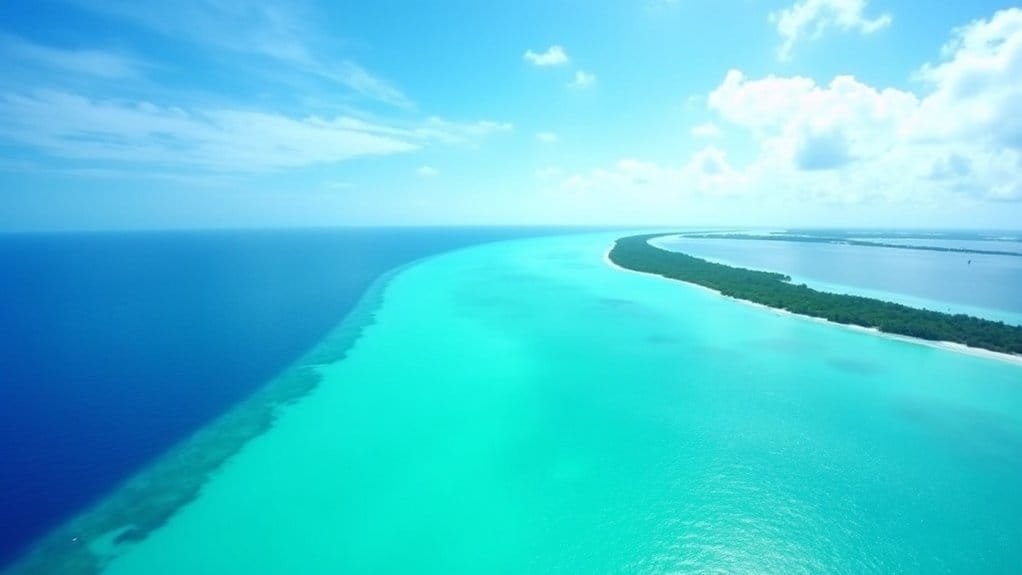
Bimini is located just 52 miles east of downtown Miami, across the Straits of Florida, making it the closest Bahamian territory to the U.S. mainland. This distance of 84 kilometers represents the shortest span between the United States and the Bahamas, which is significant for travelers seeking quick getaways.
The Gulf Stream, with its strong currents, flows through this area, resulting in unique weather patterns that can impact visibility conditions during travel.
The proximity of Bimini to Miami allows for convenient day trips and weekend excursions from South Florida. Many people choose to visit Bimini for its beautiful beaches, clear waters, and vibrant marine life. Understanding the distance between these two locations can help travelers plan their trips effectively.
It’s also interesting to note that the question of visibility applies in both directions. While it may seem feasible to see Miami from Bimini due to their close proximity, scientific calculations reveal that Earth’s curvature limits practical visibility to about 35 miles under typical atmospheric conditions.
On exceptionally clear nights and from betterd viewpoints, this range might extend slightly, but it’s generally not sufficient to see Miami from Bimini.
Understanding Earth’s Curvature and Horizon Limitations
When you’re standing at Miami Beach and gazing toward Bimini, the curvature of the Earth affects what you can see. If you’re about 6 feet tall, the horizon is roughly 3 miles away. This means that any landmass beyond that point is blocked from view due to the Earth’s shape.
Since Bimini is about 52 miles away, you’d need to calculate how far you can see based on your height and the Earth’s curvature.
This brings us to the next point: understanding how distance and height interact with visibility can help us grasp other geographical concepts, such as how tall buildings or mountains might change our line of sight.
Earth’s Curvature Basics
The Earth’s spherical shape affects long-distance visibility significantly, particularly from coastal locations like Miami. With an average radius of 3,959 miles, the curvature of the Earth causes the horizon to appear closer than one might expect. If you’re standing at sea level in Miami, the horizon is roughly 3.1 miles away.
This distance increases as you gain elevation—higher viewpoints allow for a broader line of sight, but the curvature still plays a role.
Scientific principles dictate that, even in perfect atmospheric conditions, the maximum visibility is around 35 miles due to geometric limits. While atmospheric refraction can slightly improve visibility by bending light rays, it doesn’t eliminate the constraints imposed by the Earth’s curvature.
For instance, Bimini is located about 50 miles east of Miami, which means it falls out of the typical visibility range from the coastline.
Understanding these concepts can help you appreciate the natural limitations of our environment and the reasons behind what you can see from various vantage points in Miami.
Whether you’re planning a trip or simply curious, knowing how the Earth’s curvature influences your view adds depth to your experience.
Calculating Maximum Visibility Distance
To determine if Bimini is visible from Miami, it’s important to calculate the maximum visibility distance using your elevation and the height of Bimini above sea level. The formula to use is d = 1.17√h, where d represents the distance in miles and h is the height in feet. This formula provides a baseline for understanding how far you can see based on your viewing height.
Several key factors will influence your visibility calculation:
- Observer Elevation: If you’re standing at an elevation of 6 feet, your horizon extends to approximately 3.57 miles. However, Miami’s tallest buildings, which reach much higher, can significantly improve visibility.
- Target Height: The heights of structures in Bimini contribute to the overall visibility range. If these structures are tall enough, they may be seen from a greater distance than just the horizon calculated from your own height.
- Combined Distance Threshold: Under optimal conditions, scientific calculations indicate that the maximum visibility distance is around 35 miles. However, Bimini is located about 52 miles from downtown Miami, which exceeds this theoretical limit.
Highest Vantage Points in Miami and Their Sight Lines
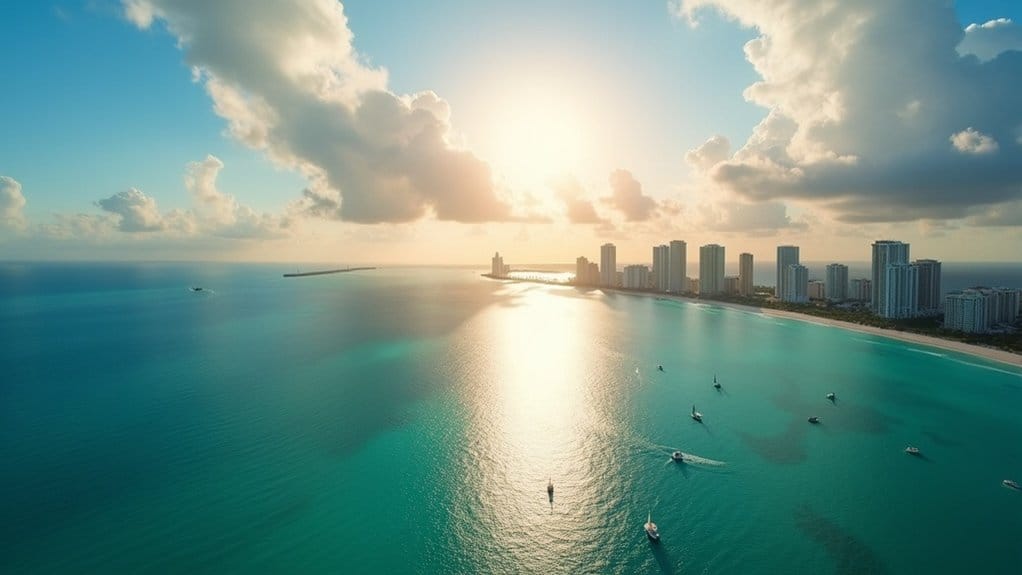
When considering the highest vantage points in Miami, such as the Panorama Tower at 1101 Brickell Ave, which is set to reach 849 feet, it’s important to understand the limitations posed by the earth’s curvature.
Despite being Miami’s tallest building, it will only allow for maximum visibility of about 35 miles. This is significant because Bimini, a popular destination in the Bahamas, is located 52 miles offshore from Miami.
The recently completed One Thousand Museum also faces similar visibility challenges. On rare occasions, under exceptional atmospheric conditions, you may be able to see the lights of Bimini, but not the land itself due to distance and atmospheric interference.
Additionally, Miami’s dense urban landscape presents further obstacles. Buildings such as Miami Tower and Brickell City Centre can obstruct sight lines, and the concentration of high-rises in downtown Miami creates visual clutter that complicates the ability to observe distant locations like Bimini.
In summary, while Miami offers some impressive vantage points, the combination of distance, earth curvature, and urban structures makes spotting Bimini from these heights unlikely.
Understanding these factors can boost your appreciation of the city’s skyline and the challenges involved in viewing distant landmarks.
Atmospheric Conditions That Affect Long-Distance Visibility
Atmospheric conditions play a significant role in long-distance visibility, especially in areas like Miami, where the subtropical climate can influence how clearly you can see across the Straits of Florida. Understanding these conditions is essential for anyone interested in spotting distant landmarks, such as Bimini, which is located 52 miles away—well beyond the typical visibility range of 35 miles due to the curvature of the Earth.
Several critical atmospheric factors impact visibility:
- Humidity and haze: Miami often experiences high humidity levels, particularly in the summer months. This moisture can scatter light, creating a haze that obscures distant views. On days with lower humidity, visibility can improve significantly, allowing for clearer views of distant locations.
- Temperature inversions: A temperature inversion occurs when a layer of warm air traps cooler air near the surface. This phenomenon can bend light rays, sometimes enabling you to see farther than what would normally be possible. These inversions can create unique viewing conditions, especially during the cooler months when they’re more likely to occur.
- Air pollution and particulates: Various sources of pollution, including urban emissions, Saharan dust, and sea spray, contribute to reduced atmospheric clarity. These particulates can diminish visibility and make it harder to see distant lights. Keeping an eye on air quality reports can help you determine the best times for visibility.
For the best chance of seeing Bimini, aim for clear, dry nights with minimal pollution. These conditions significantly improve your ability to spot distant lights and appreciate the beauty of the horizon.
What You Can Actually See From Miami Beaches and Buildings
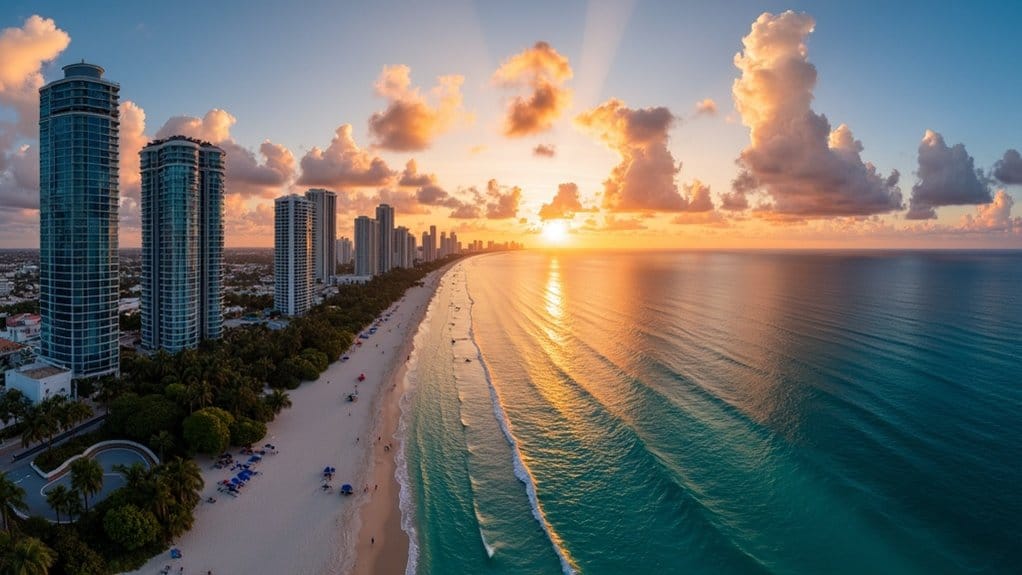
From Miami’s beaches, you won’t be able to see Bimini’s landmass because the Earth’s curvature limits visibility to about 35 miles at eye level, which is shorter than the 52-mile distance to Bimini.
However, if you’re in a tall building like Panorama Tower, there’s a chance you might catch a glimpse of Bimini’s lights on particularly clear nights, thanks to atmospheric refraction that can extend how far you can see.
While the horizon from ground level can block your view, being higher up and in darker conditions can really change things.
Speaking of views, let’s analyze some other amazing sights you can enjoy from Miami.
Miami’s Horizon Line Limits
When standing on Miami Beach, the distance you can see to the horizon is influenced by both the curvature of the Earth and your eye level, which is typically around 6 feet above sea level. In this case, your line of sight extends approximately 3 miles before it reaches the horizon.
This limitation becomes more pronounced when considering locations like Bimini, which is situated 52 miles offshore—well beyond the maximum distance that the average person can see.
Your viewing distance increases significantly with elevation. For example:
- At ground level (6 feet): Your horizon is about 3 miles away.
- From a 10-story building (100 feet): You can see roughly 12 miles to the horizon.
- From the 85th floor of Panorama Tower (868 feet): Your line of sight expands to around 36 miles.
Even at the height of Miami’s tallest building, the visible distance falls short of reaching Bimini, which remains consistently beyond the practical horizon for most observers.
While atmospheric refraction can occasionally improve visibility under certain exceptional conditions, Bimini’s landmass typically remains out of sight from Miami.
This understanding of Miami’s horizon limits is crucial for anyone interested in coastal geography or planning activities that involve long-distance visibility.
Bimini Lights at Night
While seeing Bimini during the day from Miami isn’t feasible due to the distance and the curvature of the Earth, nighttime visibility offers a different perspective. Bimini is located about 52 miles from downtown Miami, which is close to the theoretical limit for visibility. On particularly clear nights, you may be able to see lights from Bimini when viewing from higher elevations, such as the upper floors of high-rise buildings in Miami Beach.
However, scientific studies suggest that the maximum visibility range is about 35 miles, making it rare to have a clear sightline.
Visibility is heavily influenced by weather conditions. Factors such as atmospheric clarity, humidity, and light pollution play significant roles in what can be seen. While some developers may emphasize the possibility of seeing Bimini lights from penthouse suites, it’s important to note that these claims are based on ideal conditions rather than what most people experience.
When trying to spot Bimini, you’re more likely looking at artificial lights over the water rather than the island itself, which is an important consideration for setting realistic expectations.
Panorama Tower’s Claim Examined
Panorama Tower’s developer has made an intriguing claim that residents can see the lights of Bimini from 822 feet above downtown Miami. While this statement captures the imagination, it’s essential to examine it through a scientific lens to understand its accuracy.
From a height of 822 feet, the theoretical visibility range is approximately 35 miles under standard atmospheric conditions. Bimini, however, is located 52 miles from downtown Miami, making it unlikely that the lights can be seen from this distance.
Several factors play a crucial role in visibility:
- Atmospheric Refraction: This phenomenon occurs when light bends as it passes through different layers of the atmosphere. While it can occasionally extend visibility beyond the geometric horizon, such instances are rare and typically require exceptional weather conditions.
- Height Limitations: The Federal Aviation Administration (FAA) imposed a height restriction on Panorama Tower, capping it at 822 feet, which is lower than the originally planned 849 feet. This reduction also limits the potential visibility range.
- Weather Dependency: The ability to see distant lights is heavily influenced by weather conditions. On particularly clear nights, it may be possible to catch a glimpse of Bimini’s lights, but this remains a speculative scenario and not a guaranteed experience.
Comparison: Other Cross-Water Island Visibility Examples
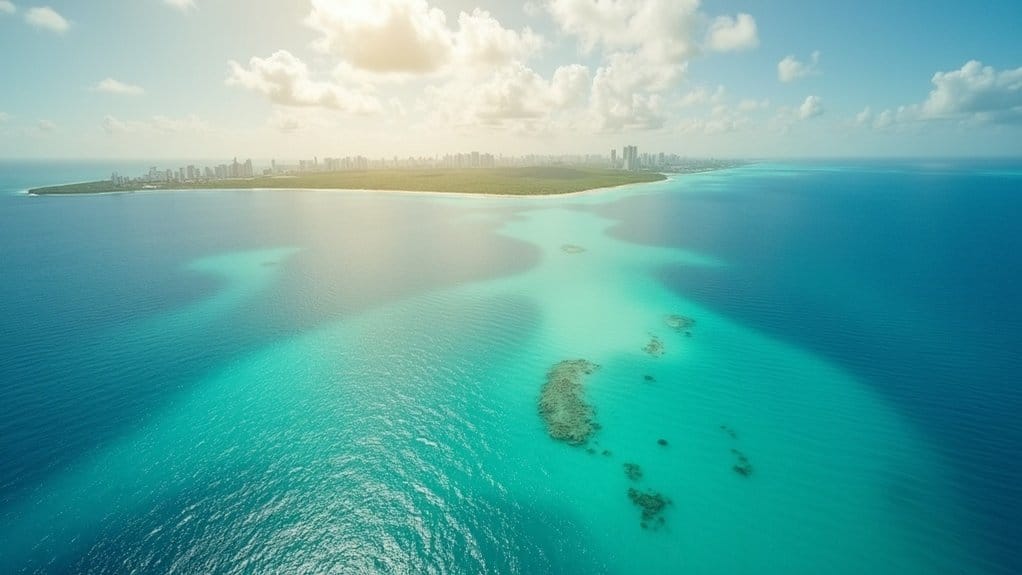
When comparing cross-water visibility distances, the Miami-Bimini corridor presents an interesting case. For instance, from Key West, you can see Cuba’s coastline at a distance of about 90 miles under optimal conditions. This distance is nearly double the 52 miles separating Miami from Bimini.
The ability to see such far-off land is primarily due to atmospheric refraction, which bends light over water and can sometimes allow us to view objects that would otherwise be hidden by the curvature of the Earth.
However, scientific calculations suggest that the theoretical visibility from Miami toward Bimini is only around 35 miles. This is significantly less than the actual distance, highlighting how real-world conditions can influence what we see.
Factors such as clear skies and low humidity are essential for these rare sightings to occur. It’s also important to understand that atmospheric refraction is affected by variables like temperature gradients and air density, which can make cross-water visibility unpredictable.
Developer Claims vs. Scientific Reality: The Panorama Tower Case
When the developers of Miami’s Panorama Tower announced that residents could see the lights of Bimini from the building’s top floor, it raised questions about the accuracy of such a claim. The tower’s height was initially designed to be 849 feet, but FAA regulations limited it to 822 feet. This reduction is significant when discussing visibility that purportedly extends 52 miles.
In reality, scientific calculations indicate that the maximum sight distance, even under ideal atmospheric conditions, is around 35 miles.
Three main factors affect visibility in this context:
- Earth’s curvature: The curvature of the Earth creates a natural barrier that limits how far we can see. This physical limitation can’t be overlooked, regardless of marketing strategies.
- Atmospheric refraction: Clear weather conditions are essential for maximum visibility, but in humid regions like South Florida, such conditions aren’t always present. Atmospheric refraction can also distort sightlines, making it harder to see distant objects.
- Height limitations: The FAA regulations directly impact the tower’s height, which in turn affects the calculations for the geometric line of sight. A lower building height means a reduced distance to the horizon.
This situation exemplifies how priorities in Miami’s competitive skyscraper market can sometimes lead to marketing claims that may not align with scientific realities.
It’s essential for potential residents and buyers to understand these factors to set realistic expectations about the views they can actually experience from high-rise buildings.
How to Travel From Miami to Bimini: Ferry, Boat, and Seaplane Options
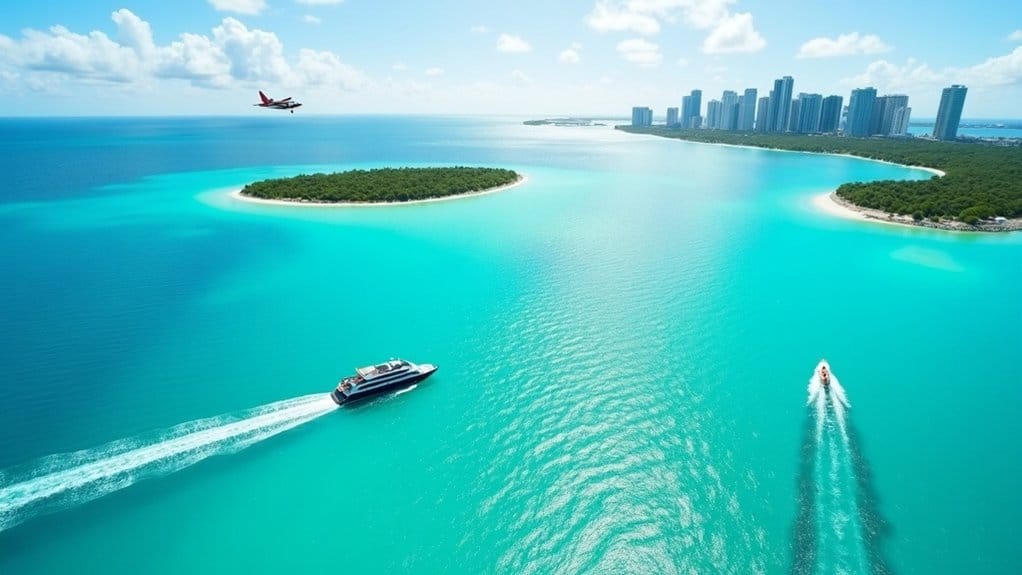
Traveling from Miami to Bimini offers several reliable transportation options, each with its own benefits in terms of speed, cost, and experience.
The Bimini Ferry is often the most budget-friendly option, with departures available from both Fort Lauderdale and Miami. The ferry crossings typically take about 2 hours, with ticket prices starting around $199 per person. Onboard, passengers can enjoy complimentary drinks and live music, boosting the travel experience.
For those who prioritize speed, seaplane services are available and can shorten the journey to approximately 30 minutes. However, this convenience comes at a higher cost, so it’s worth considering your budget when choosing this option. Additionally, private boat charters are an excellent choice for groups looking for flexibility in their travel schedule, allowing for a more personalized experience.
Regardless of which method you choose, it’s essential to remember that valid passports are required for both departure and arrival, and customs processing will take place at both points.
The ferry tends to be in high demand during peak travel seasons, so making advance reservations is advisable to secure your spot. Notably, the ferry route from Fort Lauderdale usually offers slightly shorter crossing times compared to Miami, but both routes provide picturesque views of the Atlantic Ocean, making the journey enjoyable.