

Are you worried about earthquakes while living in Miami? It’s a common concern, especially with all the talk about natural disasters. Knowing what to expect in your area can help ease your mind. Miami sits on the stable interior of the North American Plate, which plays a significant role in its seismic activity—or lack thereof.
In fact, Florida has recorded only a handful of earthquakes over millions of years, with the strongest near Miami being relatively mild. While distant tremors from Caribbean quakes might occasionally be felt, the risk of significant earthquakes in Miami is quite low. However, it’s always good to be informed about the geological landscape and consider other natural events, like hurricanes and flooding, that could impact your life. Curious about Miami’s seismic safety? Let’s dive deeper into what really matters for your peace of mind.
Understanding Miami’s Geological Setting and Seismic Activity
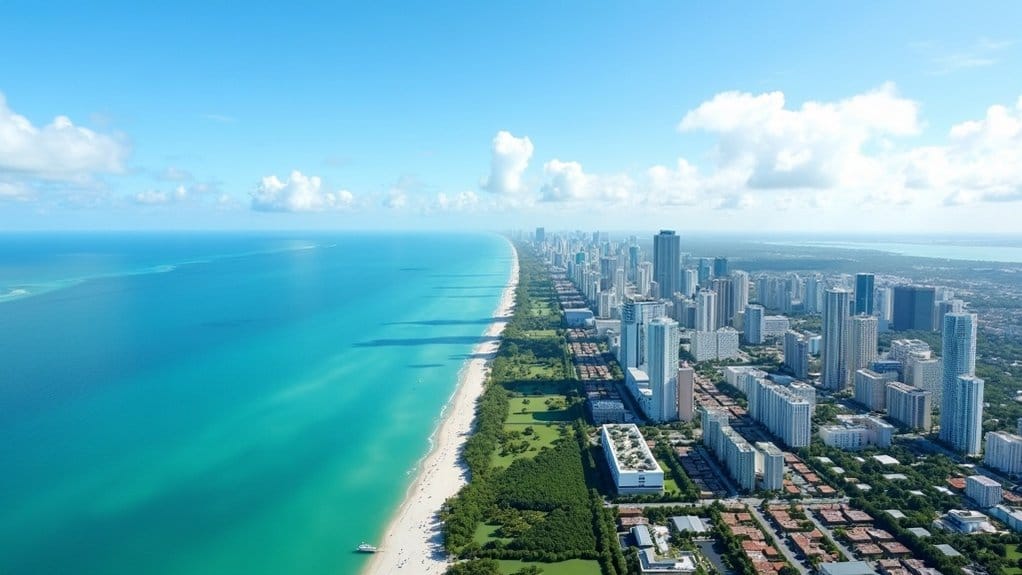
Miami is situated on the North American Plate, which is a stable geological setting far removed from active tectonic boundaries. This positioning plays a significant role in understanding the city’s seismic profile.
When considering whether earthquakes occur in Miami, it’s important to note that the data indicates very minimal seismic activity in the area. Florida’s geological history shows that significant earthquakes are quite rare, and Miami itself hasn’t experienced any noticeable seismic events in the past decade.
The most substantial earthquake recorded near Miami was a magnitude 4.3 event in 2015, which occurred 285 kilometers to the south. This highlights the fact that while earthquakes can technically happen in the region, they’re infrequent and generally not a cause for concern.
The stable tectonic environment of Miami makes these events extremely unlikely. Occasionally, small tremors are detected, but these are often linked to human activities, such as quarry blasting, rather than natural tectonic movements. This further emphasizes the distinction between Miami’s seismic characteristics and those of regions that are more tectonically active.
Historical Earthquake Records in South Florida
Historical seismic records indicate that South Florida has very little local earthquake activity, with only six recorded events over the last 1.6 million years.
Most tremors felt in Miami actually come from much farther away, like the magnitude 7.7 earthquake in the Caribbean Sea on January 28, 2020, which was 449 miles southeast of the city.
The region’s seismic history includes the 1879 St. Augustine Earthquake in northeastern Florida and a magnitude 5.8 event in the Gulf of Mexico in 2006.
Fortunately, neither of these caused any structural damage in Miami, although people did notice some shaking.
Now that we’ve covered the seismic activity, let’s look at some other natural phenomena that can impact the area.
Notable Seismic Events Recorded
South Florida is known for its low seismic activity, with only six recorded earthquakes during the Quaternary period across the entire state. This limited seismicity means that Miami experiences very few earthquakes, and when they do occur, they’re typically the result of distant seismic events rather than local fault lines.
Key Seismic Events Affecting Miami:
- January 28, 2020: A magnitude 7.7 earthquake occurred in the Caribbean, approximately 449 miles southeast of Miami. This was the largest tremor felt in the city and marked a significant moment in its modern seismic history.
- August 16, 2015: A magnitude 4.3 earthquake struck 285 kilometers to the south of Miami. This event is noted as the strongest earthquake recorded near the city since 1900.
- 1879 St. Augustine Earthquake: This historical earthquake affected northeastern Florida, generating minor structural damage in early settlements in Miami. It serves as a reminder of how even distant seismic activity can have effects felt far away.
- Anthropogenic Tremors: Occasionally, Miami experiences minor vibrations due to industrial activities, such as quarry blasting. These vibrations can sometimes be mistaken for natural seismic events, highlighting the importance of understanding the sources of tremors in the region.
Overall, Florida’s seismic profile is characterized by its rarity of earthquakes, offering residents and visitors peace of mind regarding seismic risks.
Understanding these key events helps contextualize Miami’s experience with seismic activity and emphasizes the relatively safe nature of living in this region.
Tremors From Distant Quakes
Miami doesn’t have its own seismic sources, meaning the city itself doesn’t typically experience earthquakes. However, the city’s seismograph networks have captured tremors originating from distant epicenters. For example, the 1879 St. Augustine Earthquake was significant enough to send measurable vibrations to South Florida, highlighting the impact of remote seismic events.
In more recent history, the 2006 Gulf of Mexico earthquake, which registered a magnitude of 5.8, caused noticeable ground motion in Miami, but thankfully, there were no structural damages. A particularly significant event was the 2010 Haiti earthquake, with a magnitude of 7.0, which resulted in considerable shaking felt across South Florida. This underscores the region’s susceptibility to seismic activities related to the Caribbean plate boundary.
Statistical data shows that Miami hasn’t experienced any earthquakes of magnitude 4 or higher within a 186-mile radius in the last ten years.
It’s also important to recognize that certain human activities, such as quarry blasting operations in Miami-Dade County, can produce vibrations that are detected by monitoring stations. These anthropogenic signals can sometimes be mistaken for natural seismic activity.
Understanding these factors helps residents appreciate the nature of seismic risks in Miami and the broader context of how distant earthquakes can still impact the area.
Why Florida Has Minimal Earthquake Risk Compared to Other States
Florida’s location on the stable interior of the North American Plate, far from active tectonic boundaries, is the main reason it has such a low risk of earthquakes.
Unlike states like California, where tectonic activity is common due to convergent and transform plate boundaries, Florida’s geological setting offers a different picture.
With a vulnerability score of just 5, the state has experienced only six earthquakes during the Quaternary period, a stark contrast to the thousands that occur each year in more seismically active areas.
This stability not only affects the likelihood of earthquakes but also influences various aspects of life in Florida, from construction practices to insurance considerations.
Far From Tectonic Boundaries
Miami is situated in the interior of the North American Plate, which places it far from active tectonic boundaries. As a result, the city experiences very little seismic activity. The nearest significant plate margins are hundreds of kilometers away, contributing to a stable geological environment.
This stable intraplate positioning is the reason behind Florida’s remarkable lack of earthquakes, with only six recorded Quaternary earthquakes in the entire state.
Geographic Separation from Seismic Zones:
- The closest convergent boundary is the Caribbean Plate interface, located about 800 kilometers southeast of Miami.
- The Mid-Atlantic Ridge, a divergent boundary, lies approximately 4,800 kilometers east across the Atlantic Ocean.
- The San Andreas fault system, known for its transform faults, is situated around 3,900 kilometers to the west on the Pacific coast.
- The nearest subduction zone, the Puerto Rico Trench, is about 1,600 kilometers southeast, representing the closest major tectonic activity.
In summary, Miami is located in one of the most seismically stable regions of North America, making it unlikely to experience significant earthquakes.
This stability is an important aspect of the region’s geological profile and contributes to the safety and predictability of living in Miami.
Stable North American Plate
Miami’s location on the stable interior of the North American Plate contributes to its low seismic risk. Unlike regions such as California or Alaska, where crustal stress can lead to significant earthquakes, Miami experiences minimal stress accumulation and virtually no seismic energy release. This stability is supported by the absence of active fault systems and tectonic convergence zones in the area, which are typically responsible for generating destructive seismic events.
Historically, Florida’s geological record reinforces this notion. Over the past 1.6 million years, only six earthquakes have been documented in the state, highlighting its overall stability. In practical terms, Miami’s earthquake vulnerability score is classified as low, indicating negligible expected losses for infrastructure and critical facilities. The strongest earthquake recorded near Miami since 1900 had a magnitude of 4.3, occurring 285 kilometers south of the city.
Additionally, even significant seismic events, such as the magnitude 7.7 earthquake that struck the Caribbean on January 28, 2020—449 miles away—did not result in any damage in Miami. This further illustrates the city’s exceptional seismic safety and reassures residents and visitors alike about the low likelihood of earthquake-related incidents in the area.
Understanding Miami’s geological context is essential for recognizing its reduced earthquake risk, allowing for informed decisions regarding safety and preparedness.
Low Historical Seismic Activity
Florida experiences very low seismic activity, particularly when compared to regions like California. Over the last 1.6 million years during the Quaternary period, Florida has recorded only six earthquakes. This limited seismic activity is primarily due to Florida’s geological position. The state is situated entirely within the interior of the North American Plate, which is far removed from active tectonic boundaries where most earthquakes occur.
Historical seismic records highlight the minimal impact of earthquakes in Florida. For example:
- The 1879 St. Augustine Earthquake resulted in minor tremors that caused little to no structural damage.
- The 2006 Gulf of Mexico Earthquake, despite being offshore, had a negligible impact on the state.
- In the last decade, there have been no recorded earthquakes exceeding a magnitude of 4.0 within a 186-mile radius of Miami.
- Statistically, Florida’s annual earthquake frequency approaches zero events per year.
As a result, Miami’s seismic risk profile is significantly lower than that of tectonically active regions. In places where tectonic plates interact, frequent crustal deformation and energy release lead to a higher occurrence of earthquakes.
In contrast, Florida’s geological stability provides a unique safety advantage for residents. Understanding these dynamics can help residents appreciate the low risk of significant seismic events in their area.
Natural Disasters That Actually Threaten Miami

Miami’s unique geographical location makes it particularly vulnerable to various natural disasters, particularly those related to its subtropical coastal environment. While the risk of earthquakes in Miami is low, the city must prepare for more significant threats posed by hurricanes and severe weather events.
Hurricanes are the most pressing concern for Miami residents. Due to its position along the Atlantic coastline, Miami can experience the full impact of tropical cyclones, which can bring extremely high winds, dangerous storm surges, and heavy rainfall leading to flooding. It’s essential for residents to understand these risks and have a solid plan in place for hurricane season.
In addition to hurricanes, Miami faces challenges from rising sea levels, which can exacerbate coastal flooding and lead to increased saltwater intrusion. This phenomenon poses a risk to low-lying areas and critical infrastructure, making flood mitigation strategies vital for the community.
Severe thunderstorms also pose a risk, often bringing lightning, flash floods, and, on rare occasions, tornadoes. Understanding these weather patterns and their potential impact is crucial for safety and preparedness.
Unlike earthquake preparedness, which generally requires fewer resources, Miami residents must prioritize specific strategies for disaster planning. This includes establishing hurricane evacuation routes, reinforcing buildings to withstand high winds, and implementing flood prevention measures.
Building Codes, Infrastructure, and Earthquake Preparedness in Miami
Miami’s building codes are designed with a strong emphasis on safety, particularly in regard to hurricane resilience. The Florida Building Code stipulates that high-rise buildings must be capable of withstanding wind loads of over 170 mph. This requirement is achieved through the use of reinforced concrete frames and impact-resistant materials, which also increase the structures’ ability to resist seismic forces.
To make certain compliance with these rigorous standards, Miami has implemented a series of infrastructure protocols. These include:
- Mandatory Structural Inspections: These inspections are crucial for verifying that buildings meet load-bearing specifications and for assessing the integrity of their foundations. Regular checks help maintain safety and stability as structures age.
- Seismic Monitoring Stations: Operated by the U.S. Geological Survey (USGS), these stations provide real-time geological data and automated alerts. They play a vital role in keeping residents informed about seismic activity, even though Florida experiences minimal earthquakes.
- Emergency Preparedness Kits: Each kit is designed to support individuals during emergencies, containing essential supplies such as 72-hour water rations, battery-powered communication devices, and first-aid items. These kits help residents stay safe in the event of a disaster.
- Government Infrastructure Initiatives: There’s a strong focus on retrofitting critical utilities and creating alternative evacuation routes. These initiatives make sure that, even in emergencies, residents can access safe pathways and essential services.
While Miami doesn’t frequently face significant seismic challenges, these multi-hazard resilience measures significantly boost the city’s overall preparedness.
Nearest Seismic Zones and Whether Miami Residents Need Earthquake Insurance
Miami’s geographic position plays a significant role in its earthquake risk profile. The city is located on the stable North American Plate, where seismic activity is notably rare. The closest significant seismic zone is situated 449 miles away in the Caribbean Sea, which experienced a magnitude 7.7 earthquake on January 28, 2020. However, this distance indicates that Miami faces a low probability of being affected by such seismic events.
To better understand the earthquake risk in Miami, consider the following data:
| Parameter | Miami Data | Risk Assessment |
|---|---|---|
| Plate Location | North American Plate | Minimal Activity |
| Nearest Seismic Zone | 449 miles (Caribbean) | Low Impact Probability |
| Historical M≥4 Events | Zero (186-mile radius, 10 years) | Negligible Risk |
| Recent Significant Event | M7.7 (Jan 28, 2020) | Distant Source |
| Building Code Priority | Hurricane Resistance | Adequate Structural Resilience |
The historical record shows that there have been no significant earthquakes (magnitude 4 or greater) within a 186-mile radius of Miami in the last decade. This further supports the assessment that the area poses a negligible risk for earthquakes.
In terms of building codes, Miami prioritizes hurricane resistance, which inadvertently provides some level of protection against minor seismic threats. While earthquake insurance is available, it is generally considered optional due to the low likelihood of an earthquake occurring in the region.